 The right "tools" makes everything easier--for any situation
actually. (Learned this in a "Home Repair" course; found it a truism.)
It's not rocket science that an easy-to-use, dependable walker is the
right "tool" to continue mobility and an active life.
The right "tools" makes everything easier--for any situation
actually. (Learned this in a "Home Repair" course; found it a truism.)
It's not rocket science that an easy-to-use, dependable walker is the
right "tool" to continue mobility and an active life.
But do we realize that the first walker purchased may not be the ultimate walker? Here's why--
1. We often select quickly (possibly the one used in rehab).
2. We often select the least expensive.
3. Subsequent factors, like balance and aging parent stability may lead to buying a sturdier walker.
The Right Cane
Because of R's strong desire to remain in her home of over 65 years and live independently, alone--she may have put more thought into cane selection than many.
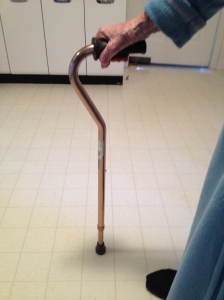 The cane she eventually purchased, she first used in rehab. While she used many canes in rehab, this one felt best to her, because of its handle, which is broad. Her palm rests on it, instead of fingers wrapping the usual more rounded handle. Thus, it felt like added support.
She was told when she left rehab 4 years ago how important it is that the cane is fit properly by someone knowledgeable. She's convinced that's why some people who, don't stand up straight and walk properly with their cane, have problems.
As parents age, inevitable problems arise. Loss of almost all vision in R's left eye and macular degeneration in her other eye are her current concerns. Mobility isn't one of them thanks to her cane and a walker (next post).
The cane she eventually purchased, she first used in rehab. While she used many canes in rehab, this one felt best to her, because of its handle, which is broad. Her palm rests on it, instead of fingers wrapping the usual more rounded handle. Thus, it felt like added support.
She was told when she left rehab 4 years ago how important it is that the cane is fit properly by someone knowledgeable. She's convinced that's why some people who, don't stand up straight and walk properly with their cane, have problems.
As parents age, inevitable problems arise. Loss of almost all vision in R's left eye and macular degeneration in her other eye are her current concerns. Mobility isn't one of them thanks to her cane and a walker (next post).
Four years ago this month R left the rehab center after spending 4 months there. Today, at 101, R is completely mobile. She now walks with a cane when she goes out (which she didn’t do before she broke her femur). She uses her cane at home when she “feels unsure.”
What has changed since R’s surgery?
To view entire post please go to my other site.


